
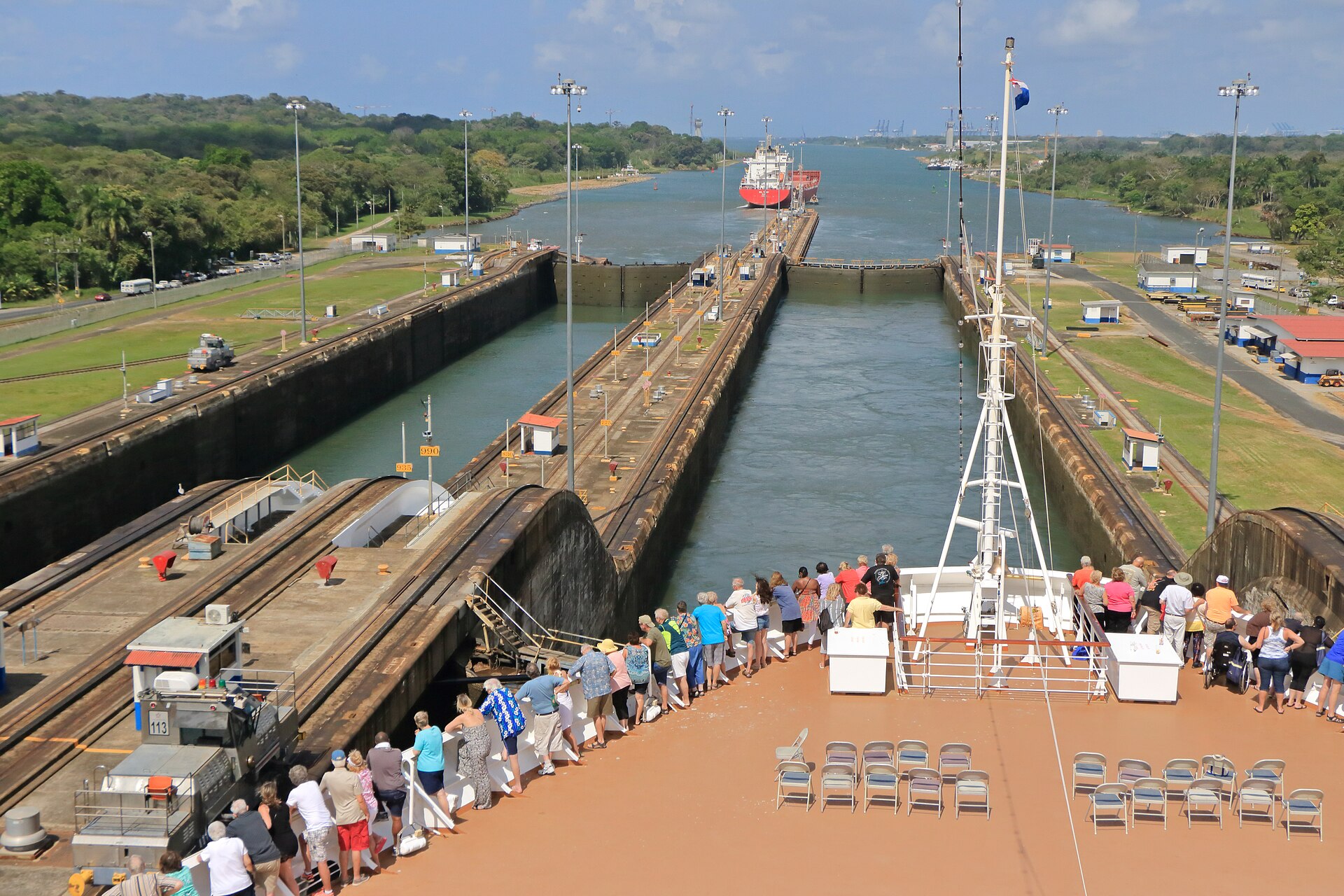
The Panama Advantage in 2026: Taxes, Canal-Driven Growth, and Global Opportunity
Territorial tax system, 10% flat capital gains, the Canal contributing 7.7% of GDP, and the $300K Qualified Investor Visa open until October. A quantitative look at why Panama works.
When a country quietly outperforms for two decades, the headlines tend to lag the reality. Panama is that case.
Average annual GDP growth in the high-4s to mid-5s for most of the past 20 years. A canal that funded the country's transition into a regional financial and logistics hub. The US dollar as legal tender. A territorial tax system. Three serious residency pathways for foreign investors. A capital city that has grown from regional outpost to genuinely cosmopolitan center inside a single generation.
None of these things, alone, sells the country. Together, they compound. This article walks through the specific fiscal and economic machinery that makes Panama work for international buyers in 2026, with verifiable numbers and sources at every step.
1. The territorial tax system, the structural advantage most outsiders discover last
Panama taxes income generated inside Panama. That's it. Foreign-source income is fully exempt, for both tax residents and non-residents.
This sounds simple, but its implications compound across an investor's entire global financial structure.
What is taxed in Panama (Panama-sourced income only):
| Bracket | Annual income | Rate | |---|---|---| | 1 | USD 0 – 11,000 | 0% | | 2 | USD 11,001 – 50,000 | 15% (on the portion above $11,000) | | 3 | Above USD 50,000 | 25% (on the portion above $50,000) |
What is NOT taxed in Panama (foreign-source income), even if you are a tax resident:
- Dividends from non-Panamanian companies
- Capital gains on non-Panamanian assets (stocks, bonds, foreign real estate)
- Rental income from real estate outside Panama
- Foreign pension income (including US Social Security)
- Interest from non-Panamanian bank accounts
- Profits from a business operated outside Panama
For an investor with international holdings, this is structurally different from the worldwide-income model used by the United States, the United Kingdom, and most of Latin America. Costa Rica has been moving toward broader taxation of foreign-source passive income for tax residents; Panama has not.
Note for US citizens:the territorial system applies under Panamanian law, but US citizens remain subject to US worldwide taxation regardless of where they live. Panama does not eliminate US filing, it provides a clean residency layer that combines well with the Foreign Earned Income Exclusion and Foreign Tax Credit strategies. Always coordinate with a qualified US tax advisor.
2. Capital gains on real estate, flat, predictable, low
This matters disproportionately for property buyers planning an exit at some point.
- Capital gains tax rate on real estate sale: 10% flat on the net gain (sale price minus purchase price and documented improvements).
- Withholding at sale: 3%of the greater of sales price or assessed value, applied at the time of transfer. This 3% withholding is creditable against the final 10% capital gains tax, if it exceeds the actual tax due, a refund can be requested.
- Same rate for foreigners and nationals. There is no separate, higher rate for non-resident sellers.
For comparison: in many home jurisdictions, foreign property gains are taxed at the seller's marginal income tax rate, which can comfortably exceed 30%. Panama's flat-rate predictability matters a great deal when modeling 5- to 20-year holds.
3. The property tax framework after Law 66 of 2017
The old 20-year exemption on new construction (Law 28 of 2012) closed to new construction permits at the end of 2018. Properties that secured the exemption before the cutoff retain it through their expiration dates, many newer condos sold today still carry residual years of exemption inherited from their original developer permits.
The current rules under Law 66 of 2017 are:
- Primary Residence (Patrimonio Familiar Tributario / Vivienda Principal) registration grants:
- Full exemption on the first USD 120,000 of cadastral value. - 0.5% to 0.7% progressive rate on value above USD 120,000.
- Secondary residential and commercial property:
- Full exemption on the first USD 30,000 of cadastral value. - 0.6% to 1.0% progressive rate above that.
In practical terms, a primary residence with cadastral value below $120,000 pays no property tax at all. Above $120,000, the effective rates are very low by international standards, far below typical US state property taxes.
4. Residency: three legitimate pathways
Three programs deserve attention from international investors. None is "shopping", all require legitimate documentation and Panamanian counsel, but all are predictable and time-bound.
Qualified Investor Visa
- Real estate threshold: USD 300,000 (until October 15, 2026, then permanently $500K).
- Alternative thresholds: USD 500,000 in Panamanian stock market through licensed brokers, or USD 750,000 fixed-term deposit in a Panamanian bank.
- Grants: Permanent residency directly (not temporary first).
- Processing time: 1 to 3 months.
- Hold requirement: investment maintained for 5 years.
- Stay requirement: none.
- Path to citizenship: eligible after 5 years of permanent residency.
Friendly Nations Visa
- For nationals of approximately 50 countries with historical ties to Panama (most of Europe, the United States, Canada, Australia, much of Latin America, Israel, Japan, Singapore, others).
- Requires: professional or economic activity in Panama (employment, business ownership, or fixed deposit).
- Grants: Permanent residency after a temporary period.
- Processing time: typically a few months.
Pensionado Visa
- For retirees with verifiable lifetime income of at least USD 1,000/month (additional $250 per dependent).
- Grants: Permanent residency.
- Discounts: entertainment, medical services, transportation, restaurants, professional services.
- One of the most attractive retirement programs in the hemisphere by quantitative score.
For investors prioritizing speed and certaintytoward eventual naturalization, the Qualified Investor Visa is the cleanest path, and the current $300K window narrows that further.
5. The Canal economy, what 7.7% of GDP actually means
The Panama Canal is the most visible piece of Panamanian economics, but the way it shows up in headlines tends to undercount its real effect.
According to IDB Invest's economic contribution analysis:
- Direct contribution to GDP: roughly 3–6%, depending on year and methodology.
- Total contribution (direct + indirect + induced): approximately 7.7% of GDP.
- Share of national exports explained by Canal activity: 15.9%.
- Share of central government income: the Canal explains approximately 23.6% of total annual government revenue, with dividends to the National Treasury as the largest single source.
In fiscal year 2025, the Canal generated USD 5.7 billion in revenue and transferred USD 2.965 billion to the National Treasury, a 20% increase over the prior year's contribution.
The strategic point: even when the Canal's direct GDP contribution is in the 3–6% range, its second-order effects, port infrastructure, logistics, Colón Free Zone, banking that finances global shipping, Tocumen airport demand, are what really drive the broader economy. The Canal is to Panama what the financial center is to Singapore: a permanent structural advantage that's very hard for any competitor to replicate.
6. Real GDP growth in context
Panama's recent and projected GDP growth, with sources:
- 2025 (actual): ~4.4% growth, recovering from the prior soft year (recent data sources).
- 2026 (projected, World Bank): 3.9%.
- 2026 (projected, IMF): 3.8%.
- Q1 2025: GDP grew 5.6%, with transportation alone expanding 26.2% on a 43.6% jump in Canal toll revenue.
- Long-term historical average (1961–2024): approximately 5.3% annually per Worldometer.
For context, the OECD average GDP growth projection for 2026 is materially below this. Panama remains one of the faster-growing economies in the hemisphere.
7. How the pieces compound for an actual buyer
You do not invest in Panama because of any single one of these things. You invest because they compound.
A buyer who closes on a $300,000–$500,000 property before October 2026, registers it as Patrimonio Familiar Tributario where applicable, files for Qualified Investor Visa residency in parallel with closing, and operates under territorial tax planning, ends up with:
- A dollarized, productive asset in a structurally growing economy.
- Permanent residency in 1–3 months, with no minimum stay requirement.
- Property tax effectively zero on the first $120,000 of cadastral value.
- Foreign-source income exempt for the residency period.
- A 10% flat capital gains tax, not a marginal-rate exposure, at eventual exit.
- Eligibility for naturalization (second passport) five years out.
None of these are loopholes. They are the published, standing rules, the same ones that have moved tens of thousands of foreign families to Panama over the past decade. They are not flashy. They are just consistent.
8. What we tell clients before any of this matters
Two things, every time.
First:the right reason to invest in Panama is structural, not opportunistic. The $300K visa window narrowing to $500K in October is a real input, but it should accelerate a decision a buyer was already going to make, not create the decision itself.
Second: the right buyer for Panama is one whose financial life is legitimately international. If your income is wholly US-sourced and you have no other meaningful global activity, the territorial tax system saves you very little and the structural case for Panama narrows to lifestyle, residency, and asset diversification, still valuable, but a different conversation than the one in this article.
We help clients honestly determine which of those two categories they're in, and what mix of property + structure makes sense for their specific case. If you'd like to run that conversation against your numbers, the first Circa discovery call is on us.
Sources
- Panama territorial tax, PwC Worldwide Tax Summaries
- Panama Tax Rate Guide 2026, Immigrant Invest
- Panama Qualified Investor Visa Guide for 2026, Global Citizen Solutions
- Panama Canal economic contribution, IDB Invest
- Panama GDP growth, World Bank Open Data
- Panama Property Taxes (Law 66 of 2017), Kraemer & Kraemer
- The Economy of Panama 2026, Retire In Panama Tours